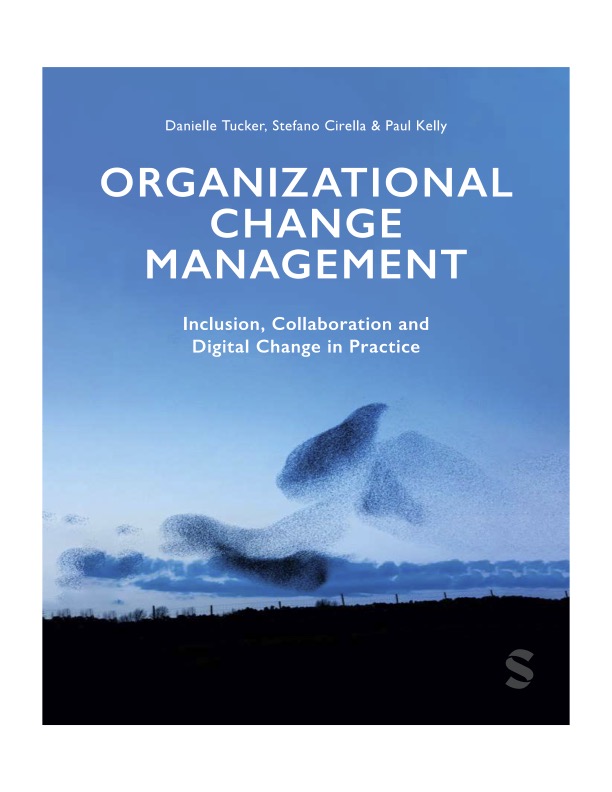
The answer: the cover image, which depicts a flock of birds changing direction, is metaphor for change. The flock of birds are so far away in the distance that they appear as a collection of dots on the horizon. You cannot see independent movement of bird’s change of direction, the effort or it’s struggles, all we can see at this distance is the movement of the flock together. This occurs through coordination with others – collaboration, interacting with others.
This resonates with the idea of flocks as complex systems by Giorgio Parisi (see Parisi, 2023), winner of the Nobel Prize in Physics in 2021. “When the flock was turning, the impression that one has is that they are turning as a flock, but the reality is that some birds start to turn in advance and the others follow. We were able to get the acceleration of each bird and to see that some birds start to accelerate or turn in one direction and other birds follow and that this decision was propagating inside the flock” (Parisi in Fox, 2023).
Organizational Change Management: Inclusion, Collaboration and Digital Change in Practice
Available now from Sage or Amazon
Inspired by our own MSc programme and the research of the co-authors, this book offers a holistic introduction to Organizational Change Management through a distinct and timely perspective of organizational change agency. It takes a highly practical and unique approach, with cutting-edge chapters on digital transformation, creativity, power and inclusivity and diversity. Our approach places change experience as a starting point. It identifies and targets lessons for current or future professionals who become change makers. Such individuals play a pivotal role in change implementation but are bounded by the ultimate decision-making power of others, typically senior leaders, executives or business owners. This focus means we place relationships and people at the heart of organizational change and offer practical training to help develop skills of communicating change; learning about change; influencing key stakeholders; handling digital data and information; consulting, supporting and exploring. We discuss not simply how to ‘do change’, but how to understand the implications of organizational changes.
 Dr Danielle A Tucker