Inspired by our own MSc programme and the research of the co-authors, this book offers a holistic introduction to Organizational Change Management through a distinct and timely perspective of organizational change agency. It takes a highly practical and unique approach, with cutting-edge chapters on digital transformation, creativity, power and inclusivity and diversity. Our approach places change experience as a starting point. It identifies and targets lessons for current or future professionals who become change makers. Such individuals play a pivotal role in change implementation but are bounded by the ultimate decision-making power of others, typically senior leaders, executives or business owners. This focus means we place relationships and people at the heart of organizational change and offer practical training to help develop skills of communicating change; learning about change; influencing key stakeholders; handling digital data and information; consulting, supporting and exploring. We discuss not simply how to ‘do change’, but how to understand the implications of organizational changes.
You can now see the recording and slides for the event to find out about our new book: Organizational Change Management Inclusion, Collaboration and Digital Change in Practice.
Just returning to my desk today after the 2023 Academy of Management conference in Boston, I thought I would share some reflections about my experience this year.
This was the first fully in person conference since the pandemic, following last year’s hybrid conference. It was great to be back in person again and experience the hustle and bustle of the conference. I was interested to see that quite a few sessions I attended included some form of hybrid attendance. I think it is great that AOM is facilitating this where possible. There will always be circumstances which mean people can sometimes not attend at the last minute and with the submission for this conference being 7 months in advance, a lot can happen in that time and an alternative form of participation is now possible. Of my own sessions, in one we had this pre-arranged and facilitated by the conference, and in one session we facilitated this ourselves via a laptop for a last minute change. In both cases, it did not seem to take much away from the discussion.
Our, now becoming regular, symposium and caucus on the strategy and change interface attracted a lot of pre and post session engagement despite being only lightly attended in real time. However, the discussion was engaging, inspiring, enjoyable and I hope fruitful for future work and directions. For me, these events are the reason to attend AOM. Although less formal than paper presentations, it is through these guided and facilitated discussions that real value is created in our scholarship. My thanks to Dr Angelina Zubac, Steven Cofrancesco, PhDPeter Bryant, especially for arranging these.
My paper presentation was scheduled for late on Tuesday afternoon. Whilst eating lunch in the Sheraton before this session, it was disheartening to see so many people already leaving with suitcases to begin their journey’s home. It is always a shame to be scheduled at the end of the programme and was evident in the poor attendance at my paper session. This was the first time in quite a few years that I have presented a paper at the conference and I was disappointed with the experience. I did however get some great feedback from the reviewers of the paper back in March, including one reviewer who introduced me to some new literature which has reshaped the way I frame the paper for the better. This makes me question the value of paper presentations at conferences… for sure, there is value in having feedback on your paper but when the value comes from the written submission rather than the presentation, it makes me wonder what this could mean for academic conferences in general. Is it worth it?
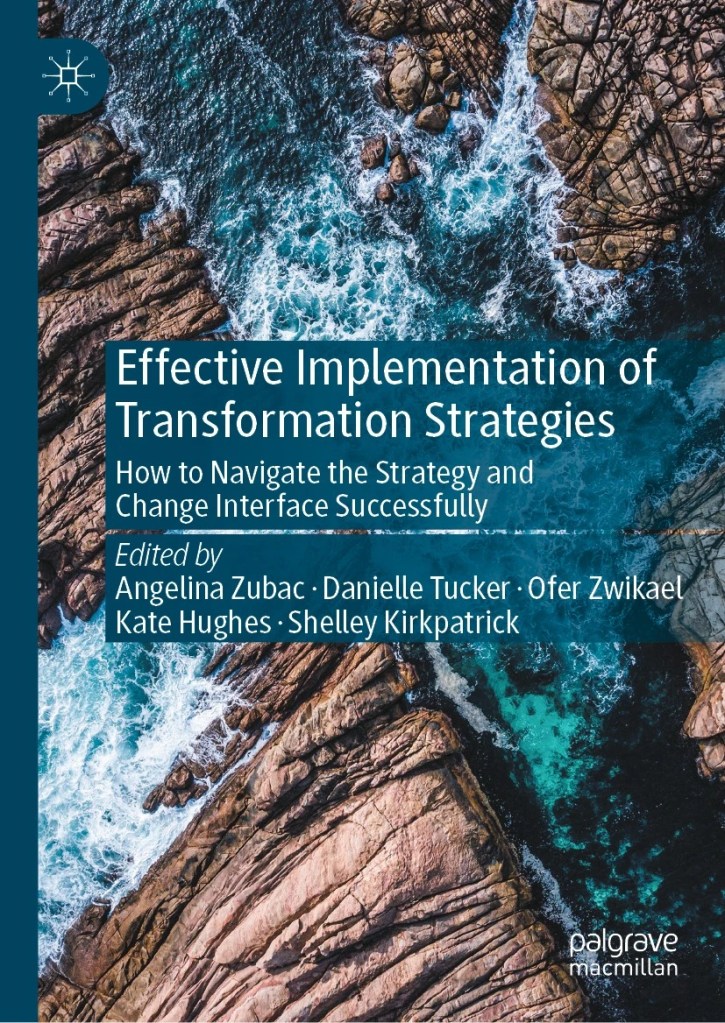
Our book, Effective Implementation of Transformation Strategies: How to Navigate the Strategy and Change Interface Successfully is now available across the world from leading outlets. We worked with leading scholars and consultants from many countries to explain how people trained in different disciplines, such as strategy, general management, change management and project management can collaborate to solve different kinds of strategy implementation problems. No matter what type of manager you are, in the top management team, a functional expert or head of a region, there will be an article that will help you gain insight into how to solve your organisation’s unique transformational and strategic problems to achieve spectacular performance results. The book is full of useful diagrams and frameworks. These are all designed to help the practicing manager and researchers keen to conduct relevant, contemporary research.
This was a wonderful project to work on the last few years (with plenty more things to come from this group too). It brings together academics and practitioners from the fields of strategy and change management. A really interesting collection of chapters including my own chapter with Dr Stella Lind on trust in family firm mergers.
In summer 2023 we started our KTP journey with Community 360, an anchor organisation that provides infrastructure support for voluntary and community organisations in Essex. I am delighted to join this research team, as the lead academic providing support co-ordinating the academic team which includes Dr Rebecca Warren (Essex Business School), Dr Anne Steinhoff (Essex Business School) and Alex Green (School of History). We now have an amazing KTP Associate in Dr Arianna Mazzieri who is placed within C360 talking on this role.
Community 360 have been working with the University of Essex for a long time already. Hear my colleagues talking about how this previous work brought us to this point and what we hope to achieve with this knowledge transfer partnership in the coming years.
Over the next three years, the project will work on:
Expanding and establishing a formalised framework for evaluation of C360’s Single Point of Commissioning (SPOC) innovation, in collaboration with partner stakeholders including Health and Wellbeing Alliance.
Developing tools and techniques to enhance a programme of asset mapping to build a conclusive picture of available resources at the county and at community levels, and work with local partners to maximise the output of these resources
Implementing C360’s medium-long term strategy, setting the organisation on a sustainable growth trajectory, while ensuring core values and ethos remain fundamental to how C360 operate
Engaging with C360 and its partner organisations to co-create and help mobilise a Community Archive as a shared asset
Funded by Innovate UK and Research Councils, KTPs are an established and successful initiative to drive innovation and growth through the transfer of expertise from a university to an external business. To find out more about KTPs at University of Essex see here.
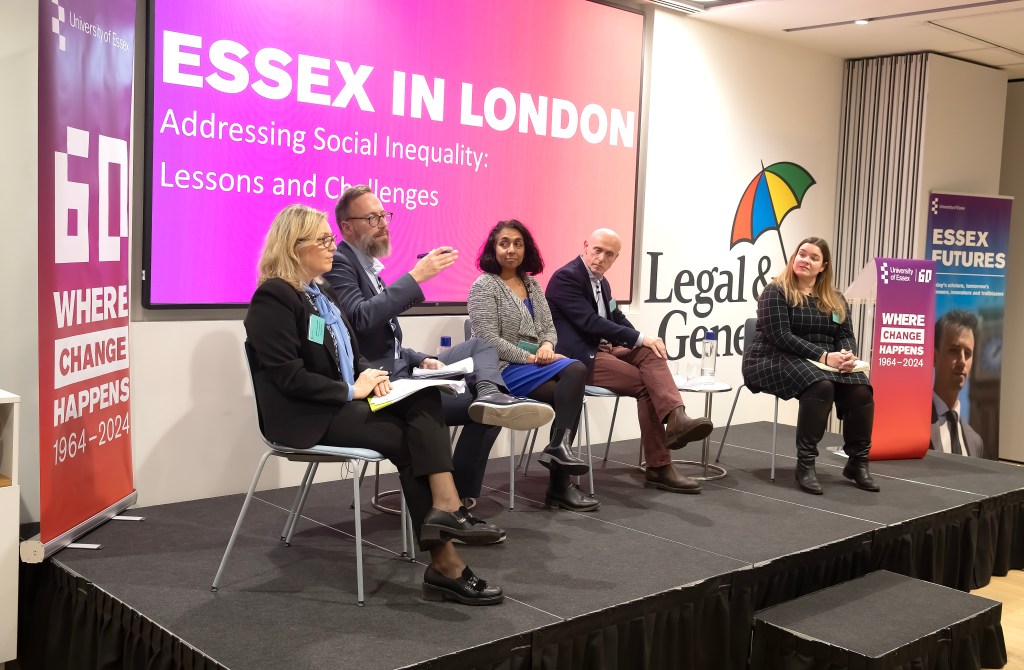
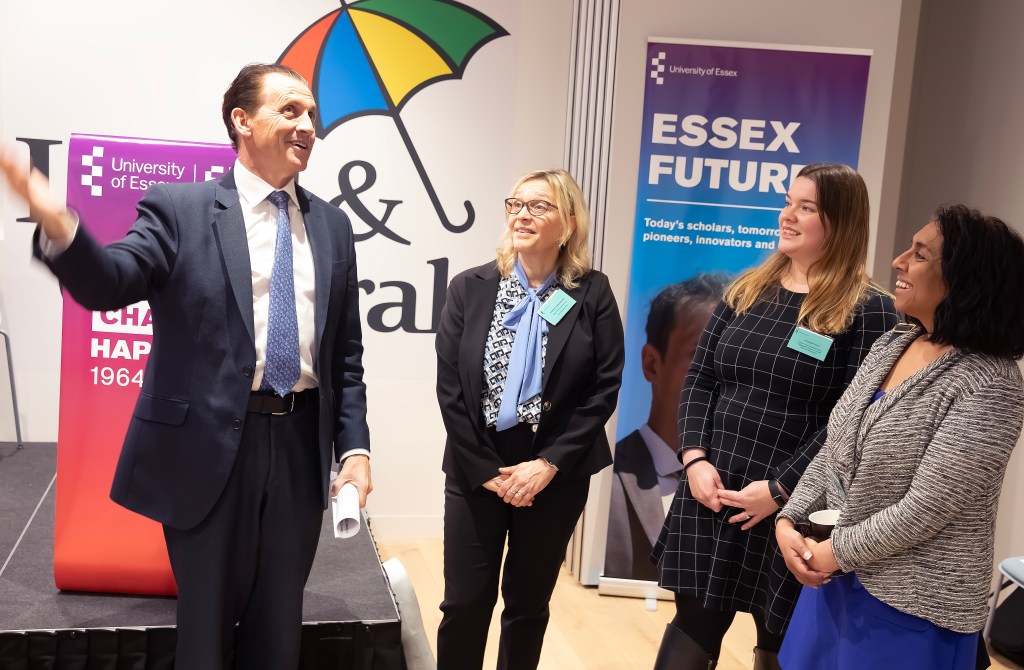
On 24 October 2023 I presented on a panel at Legal & General in London about policy alienation of frontline professionals and social inequality in health and social care
I was delighted to be invited as an expert in public sector management, to offer a public service perspective on social inequality, specifically in the context of health and social care. I talked about my research which recently examined a phenomenon called ‘policy alienation’ which occurs when frontline public professionals feel disconnected from the policies they are tasked with implementing and the core purpose of their daily work.I explained that in recent years, various health and care policies have aimed to address social inequality, including the recent initiative to integrate care within communities. However, in my research, I noticed a recurring pattern where policies initially prioritise enhancing patient experience and fostering more inclusive care, but eventually shift their focus towards cost savings and efficiency gains.
We ask employees to do more with less, leading to work intensification and more siloed working. When we prioritise data over people, front line employees feel powerless to implement policy. This is significant for several reasons, not least because front line health and care workers are best positioned to address social inequality. They understand the challenges and concerns of local community members and may even experience some of these inequalities themselves. Moreover, when front line employees lack motivation or are not empowered to use their discretion, inequalities created by the system persist.
For a full write up of the event and to hear what other panellists had to say, you can read the full event report here.
Dr Danielle Tucker from Essex Business School has won an Innovation Fellowship from the British Academy to work with global Oracle partner Inoapps to develop a new Change Agent Digital Toolkit, to support better change management.
Reader in Organisation Studies and Human Resource Management, Dr Tucker will be looking at the vital role of change agents – the individuals within organisations who promote and support new approaches, processes, business models or management structures.
The project aims to create a Change Agent Digital Toolkit that Inoapps can use to help clients support change agents. Its innovative approach places change experience as a starting point in helping organisations to implement change.
Dr Tucker said: “My research has identified that by more clearly defining roles and expectations of staff who are at the heart of change management, organisations will reduce role ambiguity and better achieve real and lasting change for their workforce and clients.
“I have found that across sectors, organisations do not understand why supporting employees who implement organisational change is essential to ensure change success. By analysing the experience of 25 change agents in large change implementation projects I will identify how change agent role activities, relationships and mindset can influence successful change management.
“By partnering with Inoapps, a consultancy organisation which specialises in supporting the implementation of Oracle applications, we will work to place change agent experience at the heart of sustainable change.”
Vicky Collier, VP Strategic Enterprise Consulting at Inoapps said: “Inoapps is passionate about supporting our customers with effective organisation change management and user adoption. A pivotal role in the success of any transformation is that of the Change Agent. The research we are conducting with Essex Business School and the British Academy will provide a deeper understanding of how organisations can profile and select the most effective Change Agent for their culture. Perhaps more importantly though, it will also help us to teach organisations how best to empower and support Change Agents throughout the life of the change journey.”
To realise this, the partnership will work towards the following knowledge exchange objectives:
To provide an evidence base and business case for a return on investment of supporting change agent experience for organisations – to help Inoapps improve its offering to clients
To build resources to help change agents reduce the stress of role ambiguity – to create a more positive experience for change agents in organisations
To encourage learning and development of project and change management skills within Inoapps’ client organisations for sustainable long-term growth
To help change agents in Inoapps’ client organisations improve individual skill development for sustainable change and address talent shortages by improving retention of experienced employees
Inoapps has already formed a good working relationship with Essex Business School as regular contributors to the Directors Workshops on the Essex MBA.
About the British Academy Innovation Fellowship
The British Academy has been funded by the UK’s Department of Business, Energy and Industrial Strategy (BEIS) to support a pilot of a new scheme, the Innovation Fellowships. The Academy is also working on this scheme in partnership with other partners, the details of which will be released in due course by the British Academy. The Innovation Fellowships scheme is a dual-route scheme designed to enable researchers in the humanities and social sciences to partner with organisations and business in the creative and cultural, public, private and policy sectors in order to address challenges that require innovative approaches and solutions. Both routes require an established researcher to work with a UK-based partner organisation on a specified policy or societal challenge that contributes to the aims of the scheme for a period of up to one year.
About Inoapps
Inoapps is an award-winning global Oracle Partner with deep cloud expertise. Trusted by our clients to deliver successful project outcomes using Oracle on-premises and cloud solutions, orchestrating people, processes and technology for operational excellence and fast return on investments. To this end, we developed the Inoapps OneTeam methodology to support our customers throughout with strategic enterprise consulting, transformational implementations, managed services, training, support services and our own software products. Inoapps works across a number of vertical industries, and has developed specialist centers in energy, engineering & construction, higher education, manufacturing, public sector and professional, business and financial services. Wondering how Oracle applications and technology can help your organization succeed? For Oracle Expertise, Ask Inoapps http://www.inoapps.com.
I wanted to highlight to you a course that I am running via Proficio. I’ve been running this course for a number of years and I’m delighted that in 2022 we will return to the original one-day, face to face format after offering this as a shorter webinar for the last two years.
The course is run through Proficio, but is open to both University of Essex postgraduate student and external participants. If you would like to sign up for the course, you can do so at this link:
A Practical Guide to Conducting Qualitative Research Interviews (6th May 2022)
This course aims to provide a practical and supportive guide for those wishing to use research interviews to collect qualitative data. Research methods courses and texts offer a wealth of information to students on types and uses of interviews and the advantages and disadvantages of their use, but there is little guidance for those new to interviewing on how interviews can be conducted in order to reveal high quality and usable data for your research. Simply turning up with a list of questions is often not enough to achieve the depth of insight which you require.
The session will facilitate discussion on the following topics:
How to arrange and prepare for interviews
Asking the right questions and getting to the truth
Robust and ethical practice for interviewing
Building trust and dealing with difficult interviewees
What to do after the interview and how to handle your data.
There is a focus on practical practice exercises which prepare students who might be interviewing for the first time to enable them to get good quality data. There is a focus on overcoming challenges and hurdles as they come up. This will be combined with additional learnings from more recent experiences of how to adapt interviews to unconventional circumstances.
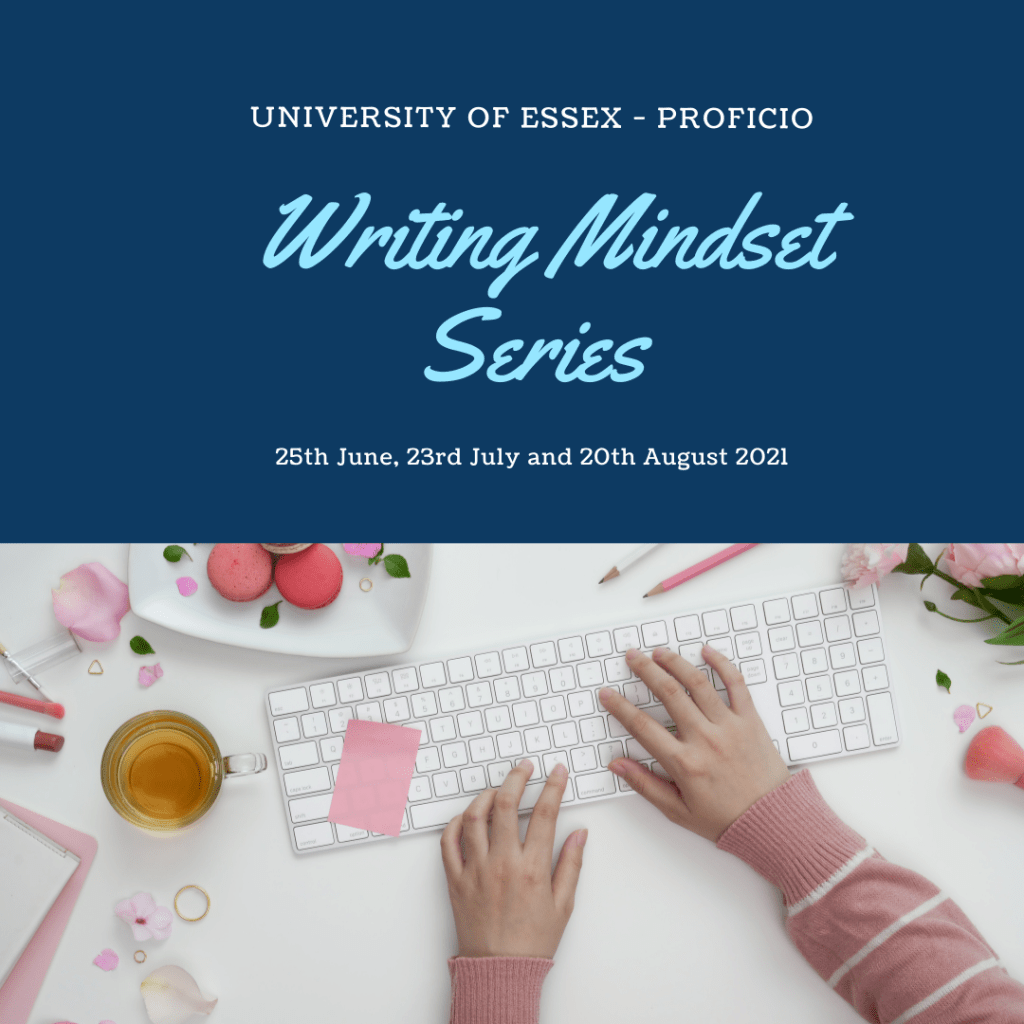
This summer I will be running a three-part series on improving your writing mindset via Proficio.
Writing is hard! Creating draft after draft, editing, responding to feedback – none of this is glamorous. Rewards are distant and producing good quality writing requires deep concentration and focus. Yet, our academic careers and reputation depend on our ability to produce manuscripts, a thesis, books, grant proposals and other forms of writing to communicate our research and contribute to a growing body of knowledge within our discipline.
The aim of this webinar workshop series is to provide a safe space to think about your writing goals, where successes and failures are part of the process. We encounter many challenges in our writing. These challenges often stem from psychological barriers which prevent us from moving forward.
Academic careers today are often dominated by performance measurement and a culture of long and unsociable working hours, constant rejection and a ‘publish or perish’ mindset. Whilst acknowledging that these systemic pressures exist, it is important to prioritise our mental health and wellbeing.
Each workshop will be useful on its own, or you can sign up to all three sessions via the links below:
In this workshop Dr Danielle Tucker will share her experience of overcoming psychological barriers to writing. We will use a cognitive behavioural coaching approach to help you avoid procrastinating, overcome perfectionism, become more resilient to writing setbacks, and manage stress.
Benefits of Attendance:
Help you create a nourishing writing mindset which positions writing as a top priority for your career, but does so in a why that is empowering rather than threatening.
Sharing the experience of writing with others demystifies the process of writing. It is an opportunity to share challenges and overcome barriers experienced by many.
Help you develop resilience-building strategies to help you stay on track with your writing journey
As a junior scholar, one professor once told me that the secret to publishing a lot was submitting a lot – the more you share you work with others, the faster you will improve and find what works. Putting our writing out into the world is hard. Whether that is submitting a paper to a conference or journal or sending it to a supervisor or peer for feedback, the process makes us vulnerable. It opens us up to the prospect of rejection – that someone will tell us that our work is not good enough, that we are not good enough! This is an intimidating process, and an emotional one.
In this workshop we will explore resilience as a process of managing emotions. Using cognitive behavioural coaching techniques, we will examine some of the thoughts we have about rejection and criticism and why these impact us so profoundly. This workshop will help you to develop your own resilience-building strategies to help you to increase your tolerance of dealing with frustrations and stay on track with your writing journey.
Benefits of Attendance:
Increase your tolerance of dealing with frustrations without the threat of failure.
Sharing the experience of writing and receiving feedback with others demystifies the process of writing.
Help you develop resilience-building strategies to help you stay on track with your writing journey
Writing goals require persistence and consistency. This is challenging because progress can be difficult to see and after a while, our motivation wains. In this session we will explore why the way we feel about these small actions (habits) may not be doing justice to the power that they have over our ability to achieve.
There are many schools of thought on what constitutes a ‘regular’ writing practice but we all have different constraints on our time, space, resources and level of focus. This workshop will explore a range of different strategies for building writing into our everyday lives (not necessarily every day or even every week). Building and sustaining impactful habits and routines, not only for writing, but to support our mental and physical well-being, will improve personal effectiveness and boost self-regulation.
Benefits of Attendance:
Help you develop routines that are rewarding and inspiring to maintain a consistent and regular writing practice.
Increase self-awareness of how to develop time management strategies which work for our own individual lifestyles and constraints.
Identify thoughts and emotions which may drain your willpower, so that you can develop routines which better reflect your values and feel rewarded every time you complete them
Further information
This course is run and managed through Proficio, at the University of Essex. This platform hosts short courses open to postgraduate research students, academic staff and professionals at universities and other organisations around the world.
This session is applicable whatever career stage you are at. As you will come to see the ‘writing process’ contains many parts, so whether you are a PhD student working on your initial ideas, reviewing literature, in the final stages of writing up your thesis, or a postdoc working on future journal articles and grant proposals, you can benefit from this session.
Essex Business School is seeking a research assistant to join the Mid-Essex health and care integration research project. This is the latest phase in a longitudinal project examining an example of a ‘place-based’ integration of single services and pilots, with a longer term aim for integration to be a cultural shift for all workers in health and social care, at all levels, across all services and in all that they do. This project is looking to understand how multiple stakeholders within the health and social care context can create a shared vision for care integration through storytelling and sensemaking.
The main responsibility of this role is to analyse a variety of data from an ethnographic study of health and social care integration in Mid-Essex. You will systematically analyse interviews, documents and observation notes, through a lens of storytelling and narrative development. You may also be asked to undertake other administrative duties relating to the project.
The successful candidate will have good qualitative analysis skills (demonstrated by previous academic and empirical research experiences e.g. student or commercial projects). As the post requires the post holder to understand various stakeholder perspectives in a complex and emerging health and social care context, critical thinking skills and excellent data management are required. The work will be carried out remotely and coordination with the research team will be via virtual meetings. The candidate should have access to their own computer and will provide their own workspace. There is considerable flexibility in working hours which can be arranged around the candidate’s own schedule.
The post could be most suited to those wishing to develop a future academic/research career, who can use this opportunity to develop a good understanding of the academic discipline of organisation studies and management. It would also be suitable for those who have an interest in health and social care integration or policy implementation.
This post is for a fixed term, part time (approx. 0.2FTE) for 3 months – 8 hours a week.
If you would like to apply for this position, please send a copy of your CV and brief cover letter outlining how you meet the criteria for this role to dtucker@essex.ac.uk by 12noon on Tuesday 6th April 2021
KEY RESPONSIBILITIES
The main duties of the post will include:
To analyse interviews, documents and observation notes from an ethnographic study of health and social care integration in Mid-Essex.
To identify the evolution of important narratives used by stakeholders in creating a shared vision for integrated care.
To discuss these findings with the research team and iteratively develop core themes and mechanisms used over time.
To write a report detailing an overview of findings from the study and to contribute to papers, articles, reports or other publications as appropriate to career stage and discipline norms.
MAIN DUTIES OF THE POST
Research
To independently perform an initial analysis of interviews, documents and observation notes from an ethnographic study of health and social care integration in Mid-Essex.
To work under the direction of the faculty members involved in the project to create and apply a theoretical lens to this analysis which will address research objectives set out by the research team.
To contextualise the analysis within a complex, multi-stakeholder policy context
To ensure that the analysis is methodologically rigorous and ethically appropriate
To organise and present data in a summary format which reflects the key findings of the study (for example, identifying illustrative quotations, data structures or key examples of themes).
To produce a brief report detailing the data analysis process and an overview of findings from the study.
Administrative
To attend regular research meetings with the project team and summarise research progress.
Leadership and Citizenship
To engage in discussions with the wider project team about future research ideas, publications and funding applications.
These duties are a guide to the work that the post holder will initially be required to undertake. They may be changed from time to time to meet changing circumstances.
Tucker, D., Hendy, J., & Chrysanthaki, T. (forthcoming) How does policy alienation develop? Exploring Street-Level Bureaucrats’ agency in policy context shift in UK telehealthcare. Human Relations.https://doi.org/10.1177/00187267211003633
Policies can fail when frontline staff feel they have limited influence on policy implementation (powerlessness), or that policy has little or no personal meaning (meaninglessness) – they become alienated from the policy. But, how does this alienation develop? In this paper we ask whether policy alienation might be viewed as a process that develops over time: a process that ebbs and flows, interacting with the policy landscape as it shifts, rather than a psychological state. Feelings of alienation can be shared across groups of actors, as they collectively shift and initiate change. This study uses participant observation and interviews with front-line employees as they navigate a UK Government Policy introducing telehealthcare to improve health management of patients with chronic conditions. We find: i) cumulative misalignment between different policy implementation contexts allows policy alienation to develop over time, ii) the shared experience of alienation in co-worker groups contributes to further misalignment, iii) front-line staff use their discretion to respond to policy alienation, which has the power to enhance or destroy policy implementation. We offer an alternative perspective for understanding how policy alienation can be prevented and policy implementation can be enhanced.









 Dr Danielle A Tucker